


- A fight over the future of the Greek bailout is brewing between two key factions
- Comes as IMF chief Christine Lagarde requests more time for Greece to meet austerity goals
- Legarde puts the IMF at odds with fiscal hawks in Germany and other eurozone nations
- European Commission official: "Even the IMF can be open to criticism. It is not the final word"
Tokyo (CNN) -- A fight over the future of the Greek bailout is brewing between two key factions overseeing Europe's debt crisis, as officials publicly disagreed with the International Monetary Fund chief's call to give Athens more time to adhere to tough austerity measures.
Olli Rehn, vice president of the European Commission, told CNN on the sidelines of the IMF meetings in Tokyo, "even the IMF can be open to criticism. It is not the final word."
His comments follow German Finance Minister Wolfgang Schäuble's rebuke of IMF chief Christine Lagarde's call to give Greece two more years to make stringent austerity measures as required for the international bailout of the country.
"When there is a certain medium-term goal, it doesn't build confidence when one starts by going in a different direction," Schäuble told the Financial Times. "When you want to climb a big mountain and you start climbing down the mountain, then the mountain will get even higher."

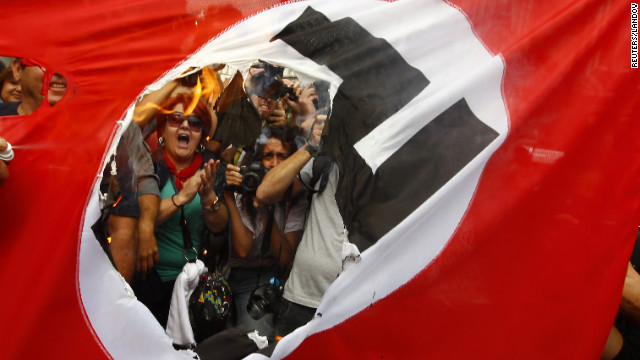 Demonstrators burn a Nazi flag during a demonstration against the visit of German Chancellor Angela Merkel in Athens on Tuesday, October 9. Merkel arrived in Greece on her first visit since Europe's debt crisis erupted three years ago, and protesters geared up to show their discontent with European Union-imposed austerity measures. See more of CNN's best photography.
  Protesters gather in front of the Greek Parliament in Syntagma Square.
 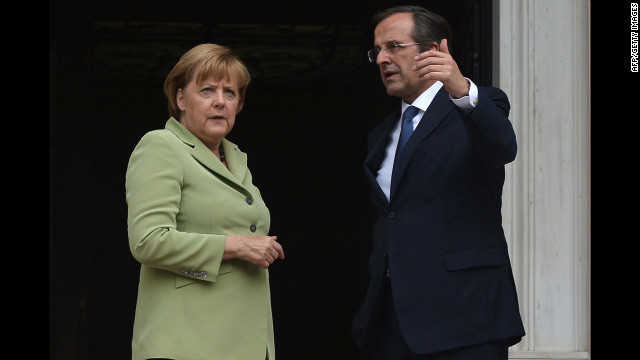 Greek Prime Minister Antonis Samaras welcomes German Chancellor Angela Merkel before their meeting in Athens.
 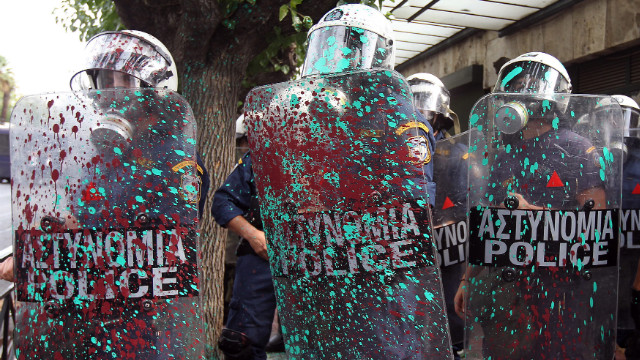 Riot police are covered with paint thrown by protesters.
  A naked protester runs past the parliament in Syntagma Square.
  Protesters shout in front of the Parliament building.
  Protesters try to kick down a barrier.
  Demonstrators dressed as Nazis ride in an open-top car in Syntagma Square.
  Protesters hold Greek flags behind barriers in front of the Greek Parliament.
  Demonstrators clash with riot police protecting the Greek parliament.
  A protester stands against a barrier erected to protect the Greek parliament. Photos: Greeks protest German chancellor's visit
  IMF chief: Austerity is hurting growth
  IMF chief: U.S. fiscal cliff a concern
 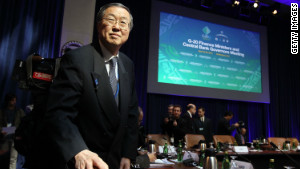 Chinese official leaves IMF meeting
  IMF economist on global risks
 Rehn told CNN "(Schäuble) has a point. The EU cannot be making swift turns, rather it is a convoy and you have to carefully consider which policy turns are best."
More: Lagarde vs. Rehn: Needed debate, or dangerous split?
The IMF is part of the "troika" which, along with the European Commission and the European Central Bank, is monitoring Greece's progress with austerity measures before approving release of bailout payments. By requesting more time for Greece, Legarde puts the IMF at odds with fiscal hawks in Germany and other eurozone nations.
"We are now on the ground with members of the troika, determined to work as hard as is needed, to make sure the program will be on track," Lagarde told CNN Thursday.
"There's a lot of work to be done, really, and the Greek population and authorities have been serious about operational changes, and they need to continue to be serious -- it's not that there can be a relaxation," she said. "However, and we've said that regularly, Greece needs more time. I have indicated to the euro partners that an additional two years would be very helpful and reasonable for Greece to meet its objectives."
Lagarde's move comes after the IMF released a study earlier this week that analyzed 100 years of public debt levels and suggested that policies that make quick fiscal cuts often exacerbate sovereign debt woes rather than solve them. The report advocates programs that stimulate growth in tandem with long-term reforms. "Reducing public debt takes time, especial in the context of a weak external environment," the IMF report said. "It is a marathon, not a sprint."
Rehn told CNN in an interview Friday, "the findings can be disputed and I am looking forward to extensive negotiations on this," he said.
Earlier this week, German Chancellor Angela Merkel visited Greece as tens of thousands rallied to show anger over the hardships the country is facing. Critics see Merkel as the main enforcer of the European Union-imposed austerity measures.

