


- NEW: SCAF calls emergency meeting following Morsy's order
- Egypt's highest court invalidated parliamentary elections in June
- Morsy's order recalling lawmakers puts him at odds with Egypt's generals
- "Reinstating parliament is against the constitution," analyst says
Cairo (CNN) -- Egypt's newly elected president announced Sunday that he's overriding a military edict that dissolved the country's elected parliament and calling on lawmakers back into session in defiance of the generals.
The move is likely to please President Mohamed Morsy's backers in the Muslim Brotherhood, which won the largest share of seats in parliament in elections earlier this year. In a statement issued to CNN, parliament Speaker Mohamed Al Katatney said he welcomed the decision and that lawmakers would convene "within the coming hours."
But it puts Morsy at odds with constitutional experts and Egypt's military, which assumed legislative power following a ruling by Egypt's highest court that threw out the vote. The Supreme Council of the Armed Forces will hold an emergency meeting to discuss Morsy's decision "and its repercussions," Lt. Col. Mohamed Askar, a council spokesman, said Sunday.
And Aly Hassan, a judicial consultant affiliated with the Justice Ministry, told CNN the order "will be met with objections from constitutional legal experts, and it may be the first test on the relations between Morsy and the Supreme Council of the Armed Forces since Morsy took office."
Photos: Egypt's historic elections
Restoring parliament would take power away from generals who ran the country for more than 16 months after the 2011 revolution that ousted longtime strongman Hosni Mubarak. The Supreme Council asserted legislative authority in June, after Egypt's Constitutional Court ruled that a third of lawmakers had been illegally elected and invalidated the election.
Presidential spokesman Yasser Ali said that under Sunday's order, new parliamentary elections would be held two months after voters approve a new constitution. The Supreme Council announced in June that it expected a new constitution to be written within three months -- a decision the leaders of Egypt's revolution protested extensively, calling it a limitation on presidential powers.

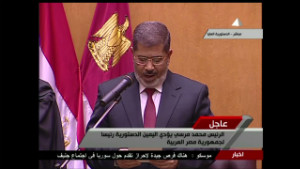 Egypt's Morsy takes over
  American fighting for freedom in Egypt
 Hassan said that as president, Morsy "has the authority to take any decision, regardless if its right or wrong." But he added, "Overturning the constitutional court ruling and reinstating parliament is against the constitution, especially that there is no appeal on such court rulings."
And retired Gen. Sameh Seif Al Yazal, the head of the Republican Center for Political Research in Cairo, called Morsy's order "an insult to the hegemony of the judicial system in Egypt."
"I think this decision puts the judicial system in a crisis, and it's a message to the constitutional court," he said. "The president is a role model. How are the Egyptian people going to respect any court rulings after that?"
Morsy, Egypt's first freely elected leader, assumed office June 30. He took the helm of a deeply divided nation that is economically strapped and lacks a working government. He quickly indicated that Egypt's legislative power would return to civilian hands -- and while praising the generals, he said their job was "to protect the boundaries and security of the country."
