



- "Rule this thing unconstitutional," says a GOP opponent of the law
- The Supreme Court should let voters decide, says a Democratic supporter
- The Supreme Court is poised to offer the final word on the constitutionality of health reform
- The high-demand hearing had people waiting outside for days to be able to attend
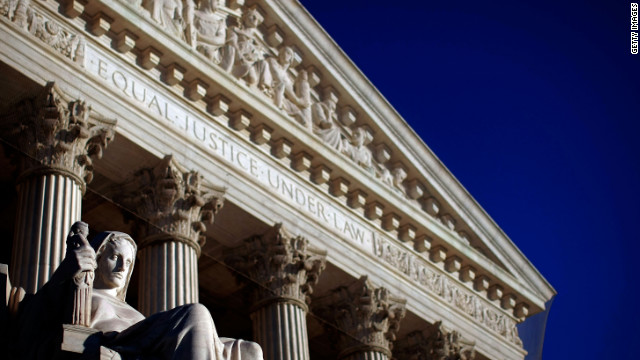
Washington (CNN) -- The U.S. Supreme Court on Monday began three days of potentially landmark oral arguments over the constitutionality of the sweeping health care law championed by President Barack Obama, with a majority of justices appearing to reject suggestions they wait another few years before deciding the issues.
In one of the most politically charged cases in years, the health care reform case drew people who waited in line starting Friday for the chance to attend, and sparked competing news conferences by supporters and opponents of the 2010 law passed by Democrats over united Republican opposition.
Hear oral arguments before the high court in the landmark case
The public sessions started Monday with 90 minutes of lively debate on a legally dense, but nonetheless important, question.
It boils down to whether the health care law's key provision is a "tax" that could prevent the court from considering the broader constitutional questions.

 Health care on Supreme Court's agenda
  CNN Explains: Health care reform
  High court takes up health care
  Obama adviser on health care, 2012 race
 The key provision involved is the "individual mandate" requiring most Americans to purchase some form of health insurance or face a substantial tax penalty.
An obscure federal law known as the Anti-Injunction Act, which dates back to 1867, bars claimants from asking for a refund on a tax until that tax has been collected and paid.
This "gateway" issue could stop the current legal fight in its tracks if the justices think the minimum coverage requirement amounts to a tax.
Several of them seemed reluctant Monday to take that route.
"This not about a tax penalty. The suit challenges the 'must-buy' provision," or required minimum coverage, said Justice Ruth Bader Ginsburg. "The 'must-buy' is separate from the tax penalty."
However, Justice Samuel Alito and Chief Justice John Roberts suggested this was a tax after all.
"The whole point (of the individual mandate) is the collection of taxes" from those who do not comply, said Roberts. "Why have a command that is toothless?"
In an unusual twist, the Obama administration is now siding with the law's opponents and strongly argued the mandate is not a tax. The high court actually designated a Washington private attorney, Robert Long, to argue in favor of the tax question.
Four mostly liberal members of the court -- including Obama appointees Sonia Sotomayor and Elena Kagan -- were aggressive in saying there was no tax at play here.
Citing the Anti-Injunction Act might give the court, particularly conservative members, a way out of deciding the explosive issue in an election year.
The majority might conclude the political branches can best resolve the conflicts, at least for now, or that the matter can be handled after the November elections.
Some court watchers have called this the health care "sleeper issue" that could potentially delay a decision on the constitutionality of the individual mandate for at least four years.
 Health care reform's day in court
  Health care law: A storybook explainer
  How to fix U.S. health care
  Ohio attorney general on individual mandate
 The larger, separate question of the individual mandate's constitutionality will be argued at the high court Tuesday.
Monday's case was Department of Health & Human Services v. Florida (11-398).
Four big issues: Breaking down what the justices will tackle
Outside the court building Monday, supporters and opponents argued their own views.
"Everything this administration has done has moved us in the wrong direction, has created such a high level of uncertainty, reduced the confidence of the American people," said Republican Sen. Ron Johnson of Wisconsin. "The Supreme Court has to do the right thing and rule this thing unconstitutional."
Democratic Rep. Robert Andrews of New Jersey said the high court should let voters decide through elections, instead of imposing a decision by nine justices.
"This court has a long tradition of deferring to the judgment of the voters, and that's what I think they will and should do here," Andrews said, adding that the health care law will "help a lot of people and help our country and that will be a great thing for our future."
According to the Supreme Court, 110 members of the public -- almost double the initial estimate -- were admitted to watch Monday's arguments, along with 117 credentialed members of the media.The justices know their eventual rulings could establish profound guidelines on the extent of congressional power and could shake up a presidential election year where health care has become a hot campaign topic.
"The social and political stakes just in this case in particular are quite significant, but even beyond that, there are broader constitutional principles," said Paul Clement, who will argue against the law before the justices. "This is a legal question and it's got a lot of people excited politically."
"The Affordable Care Act moves us very close to achieving health coverage for everyone," said Ron Pollack, executive director of Families USA, a health advocacy group. "It's my hope that the justices protect the law and allow the law to go into effect."
Health reform opponent: 'Congress made a bad situation worse'
Health reform supporter: 'It really is going to help the public'
Seats inside the court were scarce, both for interested parties and the public. Because of demand, the court's clerk told representatives from Congress, the Obama administration, the states and the dozens of private advocacy groups to decide among themselves who will attend.
For example, 26 states are leading the legal challenge before the Supreme Court, but there will only be room for six attorneys general to attend the arguments. Legal sources said those negotiations over the choices turned testy when some officials were not picked.
Blockbuster court rulings during election years
Sen. Max Baucus, D-Montana; Sen. Orrin Hatch, R-Utah; and U.S. Rep. Michele Bachmann, R-Minnesota, said they secured precious seats. Attorney General Eric Holder led the administration contingent.
And although it is little known, the justices themselves are allowed to give out up to nine tickets to anyone they want, so having an "in" with the bench might be the only way some interested parties will be admitted.
The Supreme Court: How it actually works
Dueling rallies and protests outside the court added to the charged atmosphere.
On Sunday, about a dozen people lined the sidewalk in front of the Supreme Court, along with their lounge chairs, blankets and umbrellas, hoping to obtain tickets.
Jill Andres has seen the court in action before. Andres attended hearings for the Wal-Mart discrimination case last year, and that experience has her excited to see history a second time around.
Andres said she is hoping to see the "insight into the nuances of the law that are interesting."
Two families, two views on health care reform
Others have made quite a trek to be in Washington.
"I'm here for myself and my family," said attorney Kathie Mcclure. She traveled from Atlanta and has been camping out since Friday to secure a seat into the courtroom.
"I'm interested in this issue because my kids are chronically ill. I have a son who has Type 1 diabetes and a daughter who has epilepsy."
In line to secure a rare and precious thing in D.C.
Six lawyers will make their case in what are expected to be free-wheeling question-and-answer sessions characteristic of oral arguments. The main attorneys will be Clement on one side, representing the 26-state coalition opposing the law. Defending the law will be Solicitor General Donald Verrilli.
The public will be able to listen to the oral arguments on the court's website shortly after the sessions end.
Frequently asked questions: A CNN guide to the arguments
The cases are Dept. of Health and Human Services v. Florida (11-398); National Federation of Independent Business v. Sebelius (11-393); and Florida v. Dept. of H&HS (11-400). Rulings are expected in June.
CNN's Tom Cohen, Paul Courson, Casey Riddle and Greg Clary contributed to this report.
